
Best AI Receptionist Solutions for Business (2026)

We reviewed, tested, and analyzed today's leading AI receptionist software to understand how they perform in real business environments. We looked beyond demos and marketing language to evaluate conversation quality, call handling accuracy, setup effort, pricing realities, and day-to-day manageability.
This guide is for business owners, operators, and IT leaders actively researching an AI phone receptionist and looking for an honest assessment of what each platform does well and where each falls short.
Here's a quick overview of the best AI receptionist software for 2026
- Nextiva AI XBert — Best for multi-channel coverage across calls, texts, web chat, and social messaging
- RingCentral AIR — Best for high-volume inbound calls with precise routing logic
- Quo Sona — Best for small teams wanting fast, affordable AI reception without a separate tool
- GoTo Connect AI — Best for plug-and-play AI reception with multilingual support
- Handshake — Best for professional services where conversation quality matters most
- Goodcall — Best for SMBs with high call volumes wanting unlimited minutes
- Smith.ai — Best for law firms and B2B services needing live human backup
- ZenCall.ai — Best for CRM-integrated call handling with compliance options
- VirtualReception.ai — Best for solopreneurs wanting basic AI answering at the lowest cost
- Frontdesk — Best for appointment-driven businesses wanting AI reception and lead management
The Best AI Receptionist Providers for 2026
Here are the AI receptionist platforms that stood out in testing, based on call quality, setup effort, routing, integrations, and cost.
| Provider | Pricing | Key Features | Best For |
| Nextiva XBert AI | $99/mo AI for first 99 interactions, then $0.99/interaction+ Nextiva base plan | Multi-channel handling (calls, SMS, web chat, social), calendar sync and rescheduling, context-aware call routing, real-time CRM integration, unified analytics dashboard | Multi-channel businesses |
| RingCentral AIR | From $39/mo as add-on, from $49/mo standalone | Intent-based call routing, business-hours and department logic, Salesforce/HubSpot CRM lead capture, 10-language support, context-aware live agent handoff | High call volume SMBs |
| Quo Sona | Included in Quo plans, from $19-$47+/user/mo | Unified inbox (calls, SMS, voicemails, AI), spam call filtering, call transcripts and summaries, Google Calendar booking, team collaboration on shared numbers | Small teams |
| GoTo Connect AI | Paid add-on to base plan, estimated from $10-$20/user/mo | Multilingual support (10+ languages), knowledge-base-driven FAQ answering, directory-based name routing, custom greetings and voices, real-time call analytics | Growing businesses |
| Handshake | From $199/mo or $1,999/yr | Natural conversational voice, 30+ language support, 20+ concurrent calls, mid-call texting, post-call transcripts and recordings | CX-focused SMBs |
| Goodcall | $79-$249/agent/mo | Unlimited call minutes and tokens, drag-and-drop workflow builder, custom intake forms, HIPAA-compliant flows, Zapier integration with 9,000+ apps | Budget SMBs |
| Smith.ai | $95-$500/mo | 500+ live agent backup on every plan, calendar integrations (Google, Outlook, Calendly), legal-specific CRM integrations (Clio, MyCase), bilingual English/Spanish support, AI plus human review on calls | Pro services |
| ZenCall.ai | $29-$149/mo | Inbound and outbound calling, predictive auto-dialer (Standard+), CRM integrations (HubSpot, Zendesk, Salesforce), 50+ language support, HIPAA/SOC2 compliance on Premium | Compliance-sensitive SMBs |
| VirtualReception.ai | $49-$299/mo | Auto-setup from Google Business Profile or website, appointment booking (Business+), SMS and email notifications, call transfers (Business+), text link sharing during calls | Solopreneurs |
| Frontdesk | $99+/mo | Calendar accuracy and rescheduling, built-in CRM and ticketing, 100+ premium voice options, 6,000+ integrations (Growth+), text workflows during calls | Appointment-heavy businesses |
Pricing reflects typical usage as of June 10, 2026. Actual costs vary by call volume, minutes, and integrations.
Nextiva AI XBert
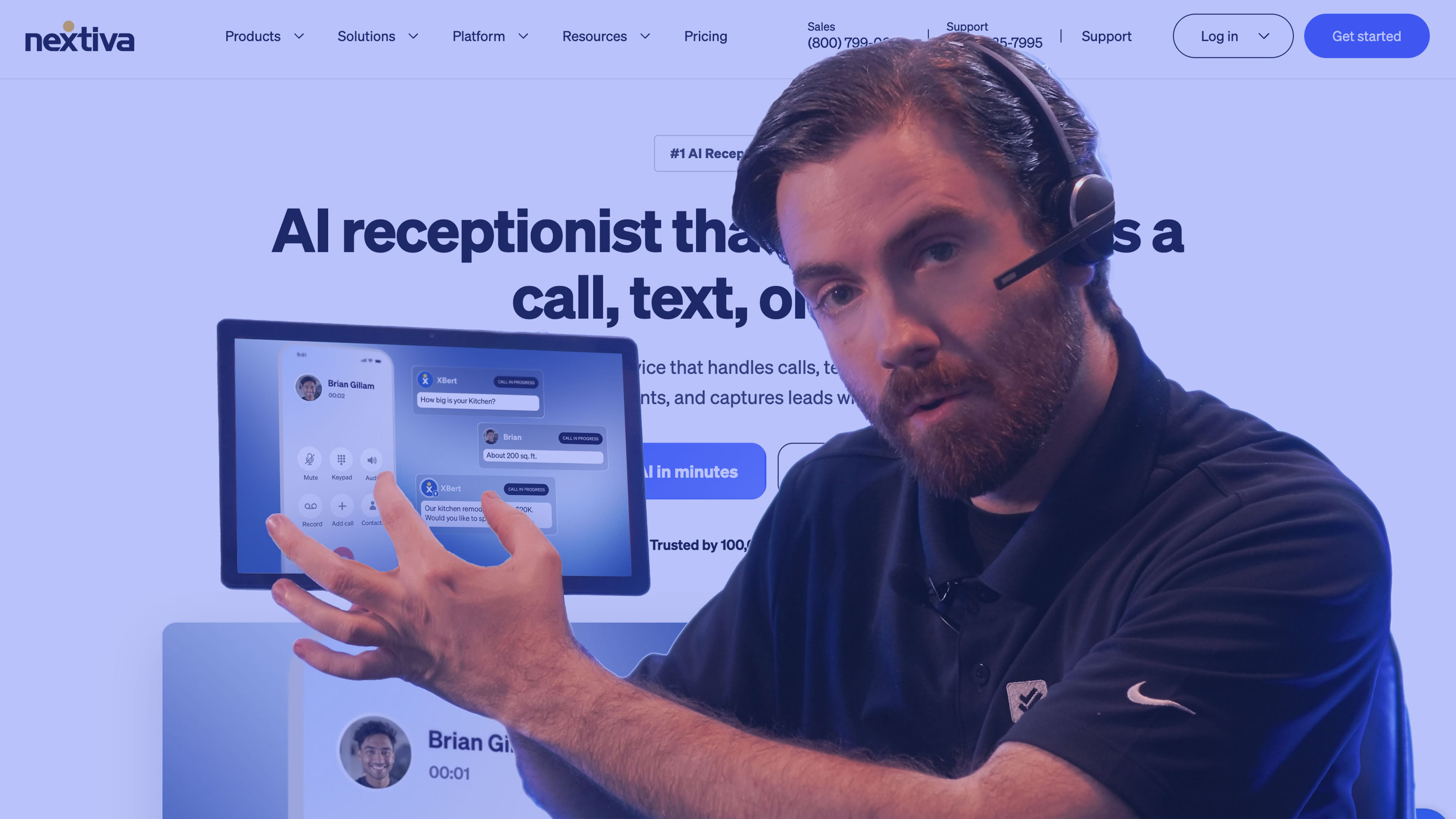
Nextiva XBert AI is one of the easiest-to-deploy AI phone receptionists we tested. XBert answers inbound calls, text messages, and web chats with a natural voice that handles common questions, books appointments, captures leads, and routes more complex calls to the right team member with full context. It does this in real time and handles multiple interactions at once. We connected it with calendars, CRM workflows, and messaging channels, which gave us a unified view of customer interactions.
XBert covers every inbound channel, calls, texts, web chat, and social messaging, 24/7, without complicated configuration or a steep learning curve. It manages appointment scheduling, automatic reminders, intelligent transfers, and real-time analytics from one dashboard, which made our day-to-day usage simpler than traditional IVRs, auto attendants, or script-based systems.
What we like
- Multi-channel conversational handling: XBert answers phone calls and manages texts, website chats, and social media messaging in a unified interface
- Smart scheduling and follow-through: Real-time calendar sync, automatic confirmations, rescheduling support, and reminders
- Context-aware routing: When a caller needs escalation, XBert captures full context and routes the call with details, reducing caller frustration and repeated explanations
- Fast deployment: We opted for the free implementation and were live in about 45 minutes
What we don't like
- Usage-based cost structure: Predictable for low call volume businesses, but harder to forecast if calls spike significantly
- Less nuance in edge cases: XBert can occasionally fall back to scripted responses when callers make highly unusual or multi-layered requests
Pricing
XBert uses an interaction-based model: roughly $99/month for the first 99 interactions (calls, texts, web chats), then about $0.99 per interaction after that.
Free professional onboarding is often included. XBert is sold as an add-on to a Nextiva plan, so total cost also includes a Nextiva subscription, which runs from $15-$75/user/month on Small Business plans and $75/user/month and up on Enterprise.
Best for: Businesses that need multi-channel coverage across calls, texts, web chat, and social messaging from a single platform.
Skip Nextiva XBert if: You only need basic voice answering and don't use Nextiva's broader platform, or you run high-volume short calls where per-interaction overages pile up fast.
RingCentral AIR
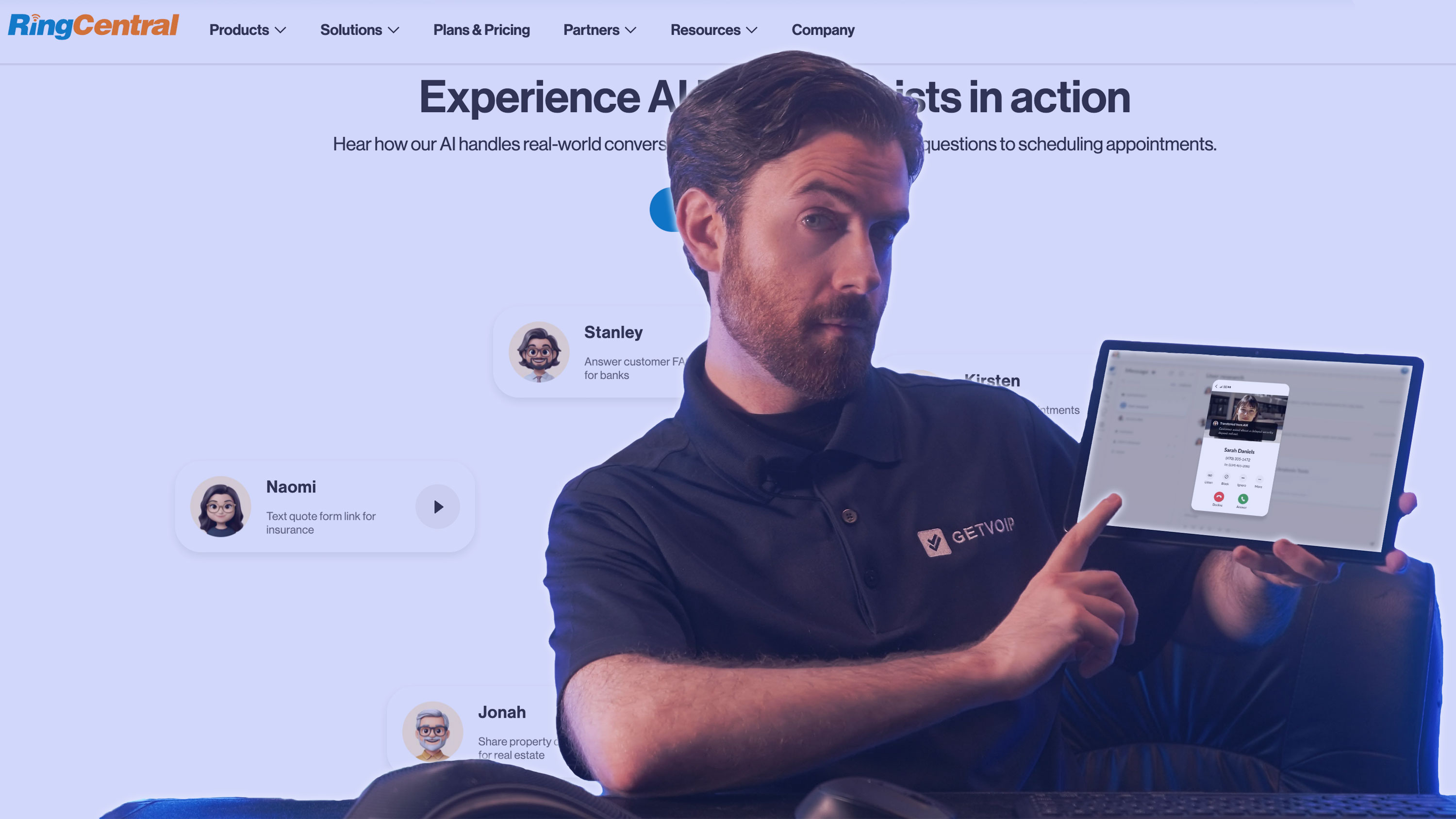
RingCentral AIR is one of the most capable AI receptionists we tested for handling structured, high-volume inbound call environments. It guided our callers through natural conversations, identified intent, and applied routing logic across departments, time windows, and call priorities.
AIR is particularly strong when call flows require precision, such as routing by issue type, caller input, or business hours. That power comes with a steeper configuration curve than what we set up.
What we like
- Clear and transparent pricing structure: Base cost includes a set amount of minutes for predictable budgeting
- Natural-language interaction: Handles typical caller intents without forcing rigid menu navigation
- Customizable greetings and routing: Businesses can tailor the AI persona, voice, and call flows to match their brand voice and operational rules
- Direct integration with RingCentral phone systems: Works inside RingCentral's voice stack, simplifying rollout and management
What we don't like
- Minute-based billing needs monitoring: If you consistently exceed the included minutes, costs can scale with usage
- Conversational depth: Less sophisticated for highly nuanced dialog compared with some AI-first competitors
- Reporting and analytics: While useful, analytics are lighter than larger contact center-focused products
Pricing
RingCentral's AI Receptionist is available from $49/month/account (100 minutes included) as a standalone tool, with additional pay-as-you-go charges from $0.50/minute or via 100-minute bundles. RingCentral AIR is also available as a paid add-on to RingEX, with pricing from $39/month plus the RingEX Core plan from $30/month. This option lets businesses scale up without committing to large upfront amounts of capacity.
Best for: Structured, high-volume inbound call environments that need precise routing logic across departments and business hours.
Skip RingCentral AIR if: You're not on RingEX or planning to migrate, or your call volume spikes unpredictably and minute-based billing could run up without warning.
Quo Sona
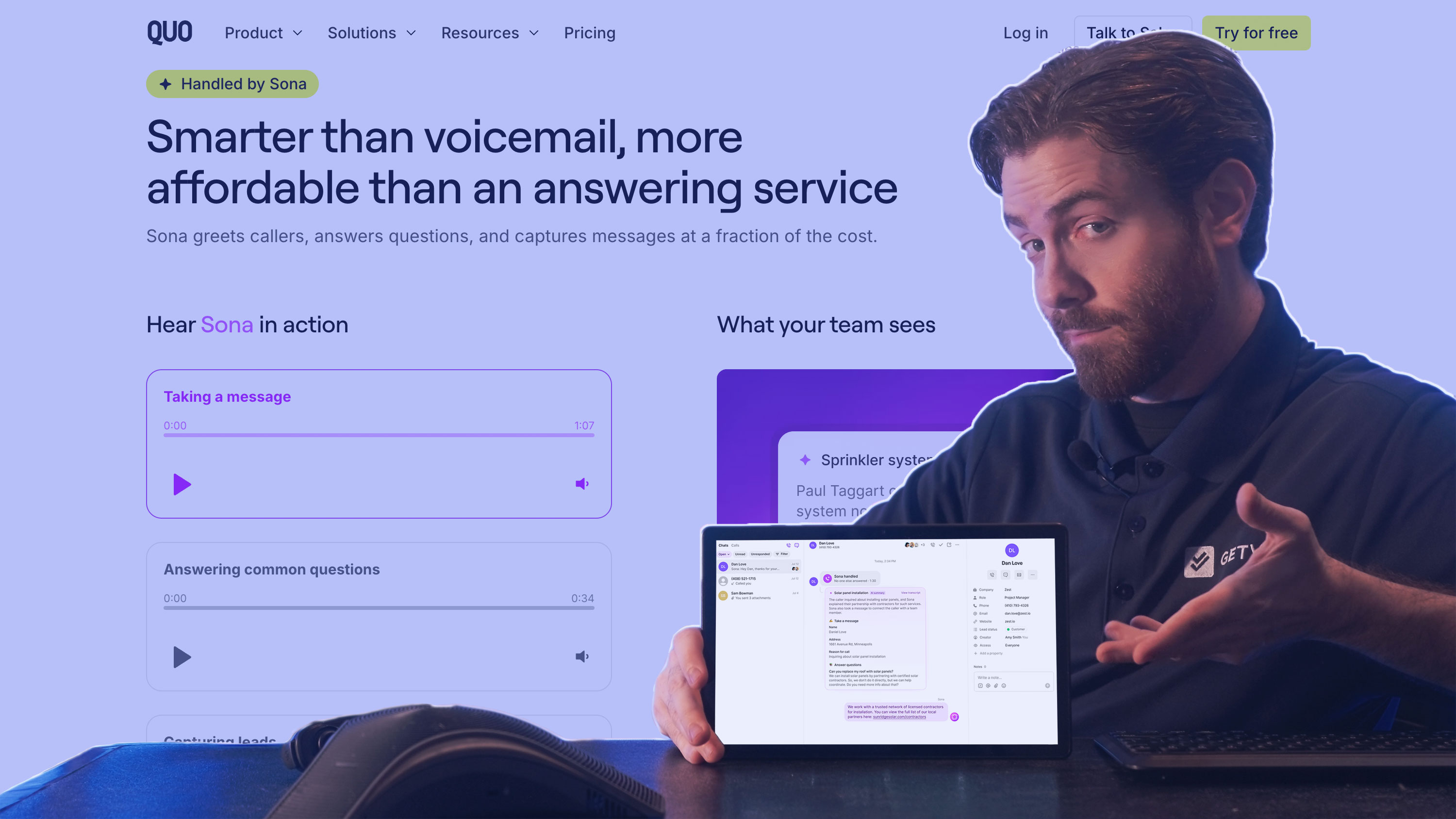
Quo Sona is the AI receptionist built into Quo's business phone platform, designed for small businesses that want conversational call handling without spending days configuring workflows or scripts. It answers calls, handles intake and routing, and takes care of basic caller questions with no onboarding calls or multi-step configuration required.
Sona is included on every Quo plan rather than sold as an add-on. The AI receptionist lives inside Quo's unified inbox, so calls, texts, voicemails, and AI interactions all land in one place. Your team can collaborate on conversations, hand off follow-ups, and maintain full context without switching tools.
Sona also filters out spam calls and conversations under 15 seconds so they don't count toward your usage, which keeps costs honest. Live calls handled intake, routing, and basic questions cleanly.
What we like
- Very fast setup and onboarding: We configured basic greetings, business information, and call handling rules without technical expertise or a dedicated onboarding session, faster than any other platform we tested
- Natural, straightforward conversational flow: Callers interacted with the AI without obvious friction on routine requests, and the voice quality was clear and professional
- Unified inbox across channels: Calls answered by Sona are recorded with full transcripts and summaries, all visible alongside your team's texts and voicemails in one shared workspace
- Low ongoing management overhead: Once configured, the system requires minimal attention, which suits business owners who lack time for continuous optimization
What we don't like
- Limited advanced routing and escalation logic: Businesses needing conditional routing based on caller input, time of day rules, or priority queuing will find the options restrictive compared to other platforms
- Smaller integration ecosystem: Native connections are limited primarily to Google Calendar and basic CRM tools, so teams relying on industry-specific software may need workarounds
- Less suited for complex, multi-department environments: The platform handles single-destination routing well but struggles with scenarios requiring caller qualification or departmental transfers
Pricing
Quo offers three base phone plans ranging from $19 to $47 per user per month, and Sona is now included on every plan with 1,000 free automation credits (roughly 10 calls) per month.
Businesses that need more volume can add a Sona tier starting at $25/month for 40 calls, scaling up to $199/month for 600 calls.
Per-call overage rates decrease at higher tiers, ranging from $1.00 down to $0.45 per call. Spam calls and conversations under 15 seconds are excluded from your usage count.
Best for: Small teams that want a fast, affordable AI receptionist built into their business phone system without managing a separate tool.
Skip Quo Sona if: You run a multi-department business with conditional routing needs, or rely on industry-specific software outside the Google Calendar and standard CRM ecosystem.
GoTo Connect AI Receptionist
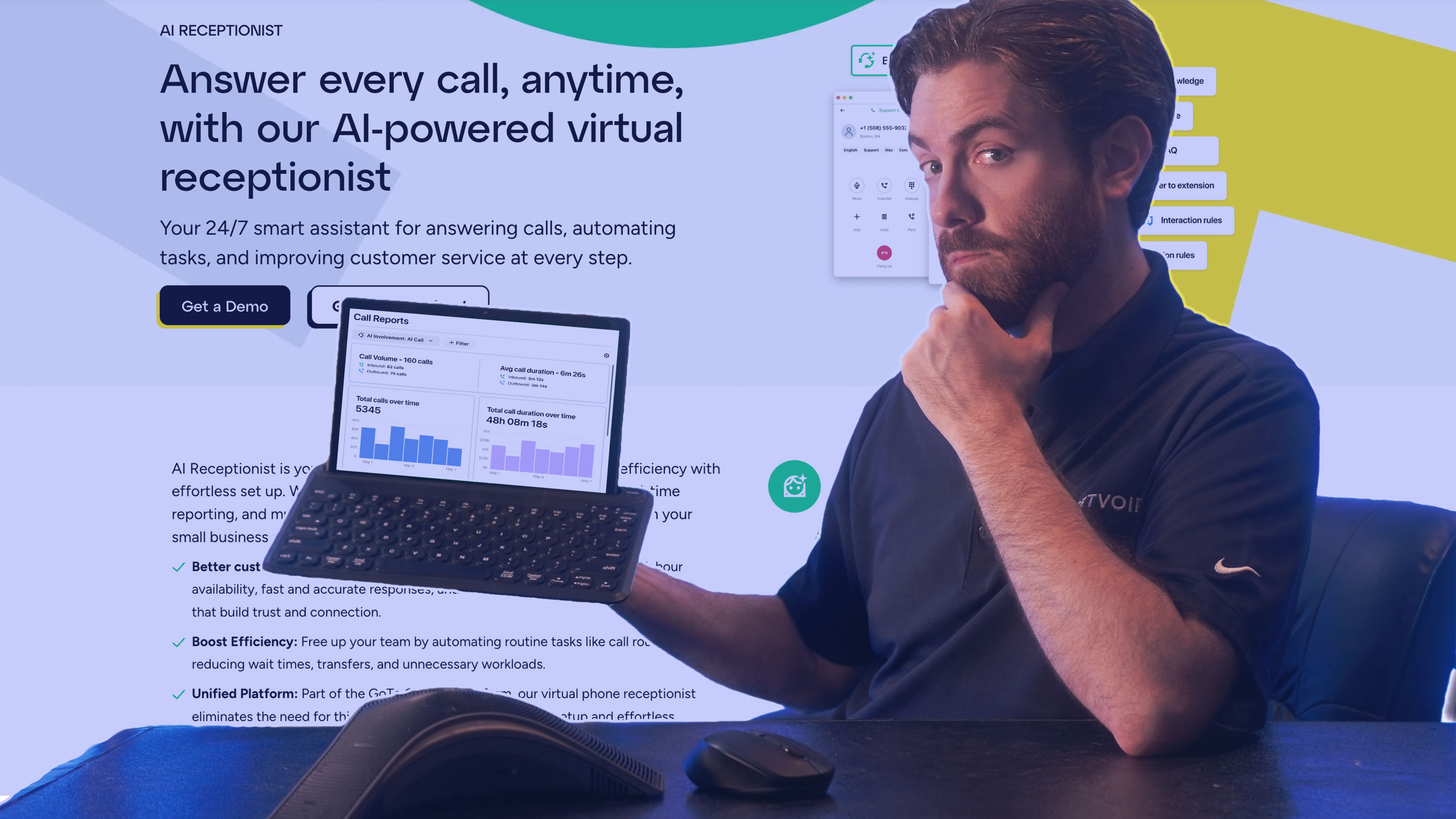
GoTo Connect provides cloud-based phone systems with integrated AI reception capabilities focused on simplicity and reliability for growing businesses. The mobile-first design lets teams manage AI reception settings and monitor performance from anywhere, which works well for remote and hybrid teams.
GoTo Connect's customization includes custom greetings, multilingual support (10+ languages), and the ability to build AI call flows from your knowledge base so the AI answers FAQs without escalation. The built-in dashboards show how calls are being handled and what responses the AI is generating, which helps teams refine call logic over time.
GoTo Connect is easier to launch than enterprise contact center tools, but advanced knowledge-base setup still takes admin work.
What we like
- Rapid configuration: The AI receptionist is ready to work within minutes and doesn't require technical expertise to get started
- Multilingual and customizable interactions: Businesses can tailor greetings, voices, and languages, with support for 10+ languages out of the box
- Information capture and analytics: Captures meaningful call details and shows real-time analytics that help you refine responses and follow-up actions
- Directory integration: If callers want to reach a specific person, the AI can route by name or role using your synced directory
What we don't like
- Bundled into broader plans: The AI receptionist is part of GoTo Connect's unified platform, so standalone pricing is not clearly published; costs are tied to broader phone or contact center plans which can make cost forecasting harder
- Less conversational nuance than some AI-native competitors: While effective for routine calls, it doesn't yet match the flexibility of AI-first engines on highly unpredictable dialogs
- Implementation complexity increases with scale: For more advanced workflows or deeper knowledge base training, teams may need dedicated admin effort
Pricing
GoTo Connect doesn't list flat AI receptionist pricing on the public site because the service is included as a capability of their UCaaS and contact center plans rather than a standalone product.
Best for: Growing businesses on GoTo Connect that want a plug-and-play AI receptionist with multilingual support and no-code call flow design.
Skip GoTo Connect AI if: You're not committed to GoTo Connect's platform, or you need standalone, transparent AI receptionist pricing you can forecast separately.
Handshake
Handshake had the strongest conversation quality of the AI receptionists we compared. Calls felt paced and professional, which matters for businesses where first impressions affect retention. The AI handled conversational pauses, acknowledged caller statements appropriately, and maintained a professional tone throughout interactions.
Handshake handles open-ended requests better than most. When callers did not follow expected patterns or phrased questions ambiguously, the system adapted, asking clarifying questions rather than defaulting to a transfer. Most AI receptionists struggle when conversations go off-script, but Handshake stayed on track in scenarios that tripped up other platforms.
That said, Handshake is still a growing platform, and while it excels in dialog quality, it currently offers fewer integrations, more limited setup options, and lighter analytics compared to larger vendors.
What we like
- Very natural conversational tone: The AI's pacing, word choice, and response timing felt notably human compared to competitors
- Strong intent recognition: Even when callers expressed needs indirectly or used non-standard phrasing, the system correctly identified what they were asking for in most scenarios
- Good handling of open-ended caller requests: Rather than forcing callers into rigid menu structures, the AI allowed natural conversation flow and responded appropriately to varied inputs
What we don't like
- Smaller integration ecosystem: Native connections are limited compared to established platforms. Teams using specialized tools may need manual workarounds or Zapier connections
- Limited reporting depth: Analytics provide basic call counts and outcomes, but detailed conversation transcripts and trend reporting are either limited or unavailable
- Less suitable for highly structured call routing: Businesses needing complex conditional routing or multi-tier escalation will find the options insufficient
Pricing
Handshake uses a flat monthly subscription model:
- Monthly plan: $199/month
- Annual plan: $1,999/year (saves approximately $400 compared to monthly billing)
- Usage model: Pricing covers the service subscription, which includes 600 live minutes per month and offers additional 100-minute bundles from $25
Handshake sits in the mid-to-upper range of AI receptionist pricing, but the conversation quality may justify the premium for businesses where call handling directly impacts client acquisition.
Best for: Professional services and client-facing businesses where natural conversation quality and first impressions matter most.
Skip Handshake if: You need deep CRM integrations, complex routing, or detailed analytics, or your call volume is too low to justify the flat $199/month.
Goodcall
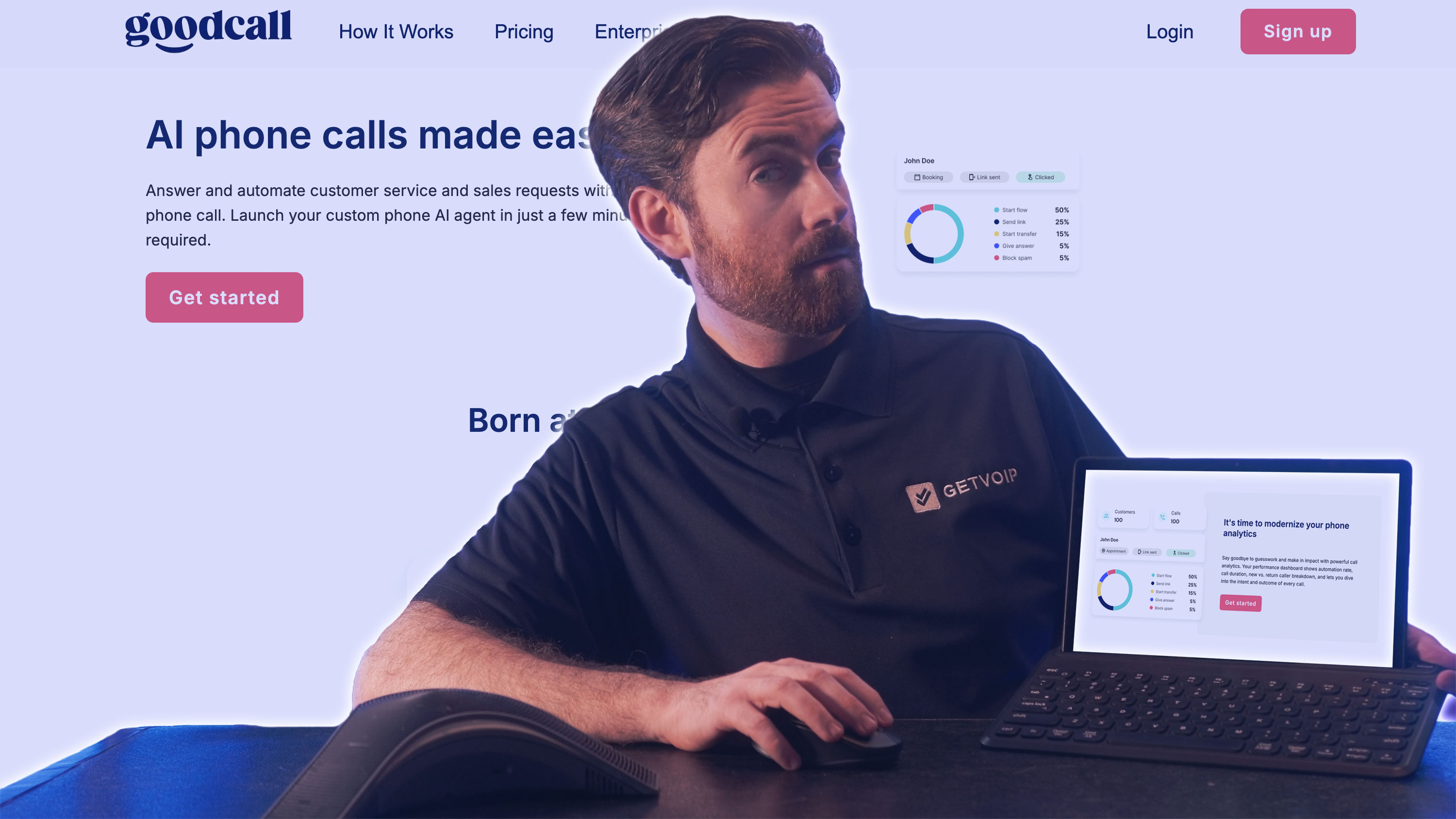
Goodcall is built for SMBs that want dependable call intake without complexity. Setup took us about 25 minutes to configure basic greetings and call handling rules, and the platform handled common inbound scenarios consistently.
Goodcall's main differentiator is its pricing model. Rather than billing per minute or per call, Goodcall charges based on the number of unique customers your AI agent interacts with each month. All plans include unlimited minutes and tokens, so long calls don't eat into your budget. The AI captures caller information, provides requested details, and can route urgent calls to designated numbers.
What we like
- Easy deployment: The onboarding process is straightforward, with guided setup that walks users through configuration without requiring technical knowledge
- Unlimited minutes on every plan: Unlike most competitors that bill per minute or per call, Goodcall includes unlimited call minutes and AI tokens across all tiers. You only pay based on unique customer volume
- Affordable and predictable pricing: The unique-customer model makes it easy to forecast monthly costs, especially for businesses with repeat callers or longer average call durations
What we don't like
- Limited customization options: Beyond basic greetings and business information, the platform offers fewer configuration options than competitors
- Not ideal for complex routing or multi-step flows: Calls requiring conditional logic or departmental routing based on caller input are better served by more advanced platforms
- Basic analytics: Reporting covers essential metrics but lacks the depth needed for detailed performance analysis
Pricing
Goodcall bills by unique customers served per month rather than by minutes or calls, so every plan includes unlimited minutes and AI tokens.
Plans range from $79 to $249 per agent per month, scaling on the number of unique customers, forms, logic flows, and team members.
Extra customers run $0.50 each past your cap, and annual billing saves 30%. Enterprise plans add CRM integration for larger operations.
Best for: SMBs with repeat callers and longer call durations that want unlimited minutes and predictable monthly costs.
Skip Goodcall if: You're actively marketing for new leads, since the per-unique-customer model penalizes growth and hits overages quickly.
Smith.ai
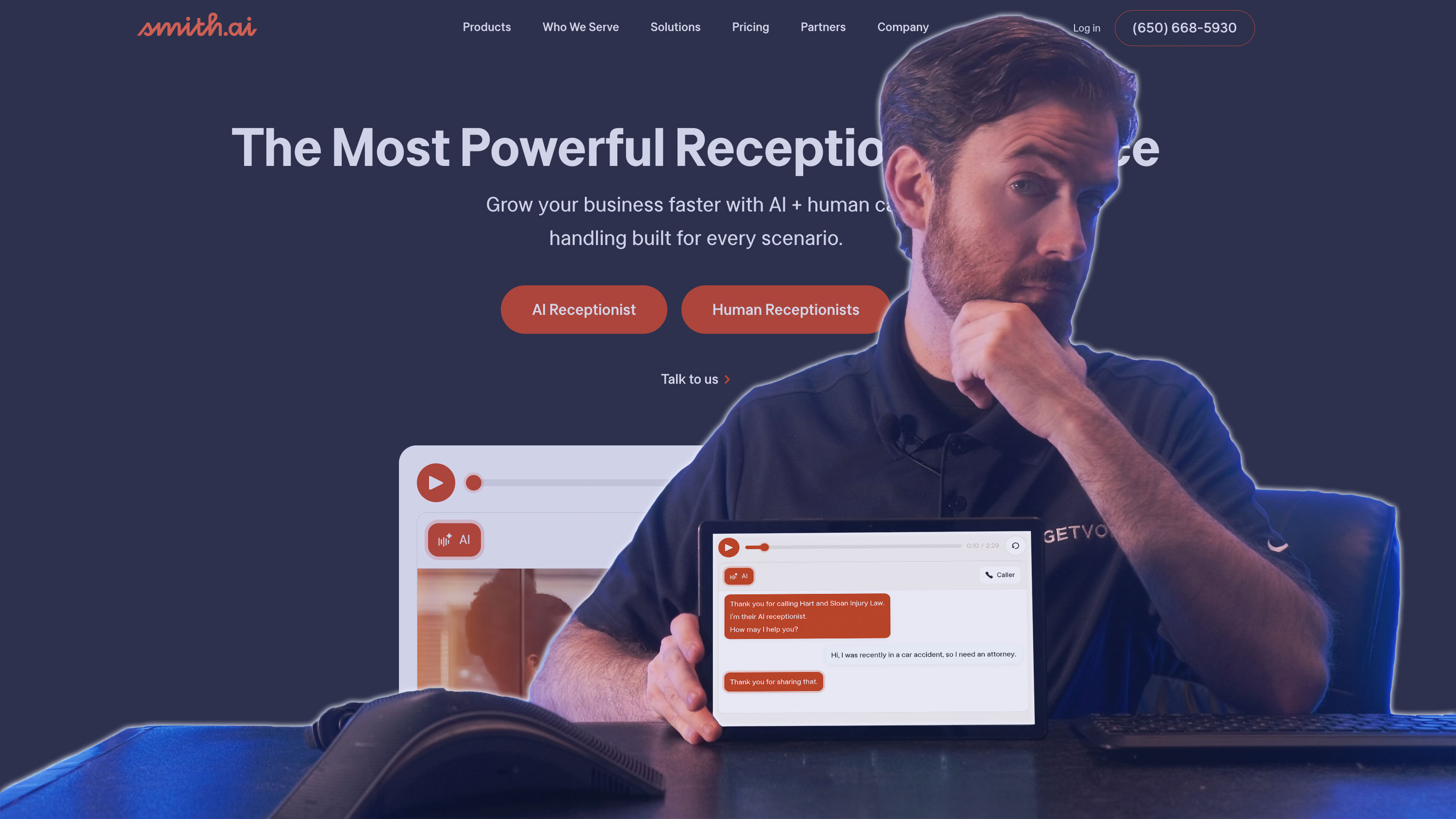
Smith.ai backs every AI receptionist plan with 500+ live agents, unlike most providers on this list. The hybrid model handled calls reliably, especially for professional services and high-value inbound calls where a missed call has real revenue impact.
AI handles initial call intake and routine requests, with live North America-based receptionists available when conversations require human judgment or sensitive handling. The handoff between AI and human agents was smooth enough that callers often did not notice the transition.
Smith.ai offers two tracks: a self-service month-to-month option for businesses with simpler call flows, and a done-for-you annual plan that includes dedicated AI experts, custom integrations, and ongoing optimization. The self-service plans are commitment-free and easy to start with, while the annual plans deliver the deepest customization and best per-call value at higher volumes.
What we like
- Strong call quality and consistency: The combination of AI efficiency and live agent backup produced the most reliable call handling. Every plan includes access to 500+ live agents, not just the premium tiers
- Excellent appointment scheduling: The platform integrates with major calendar systems and handles booking, rescheduling, and cancellations accurately across a wide range of native integrations
- Smooth escalation when automation is not enough: When callers presented complex situations or expressed frustration, live agents stepped in without awkward delays or repeated information
What we don't like
- Per-call pricing adds up quickly: Self-service plans run $1.60 to $1.90 per call with $2.40 overages, which gets expensive for businesses with high call volumes or unpredictable spikes
- Self-service plans are limited: Month-to-month plans do not include custom integrations, dedicated support, or call flow customization. Unused calls also expire monthly with no rollover
- Significant jump to annual plans: Done-for-you plans start at $500/month billed annually, which is a steep commitment for smaller businesses still evaluating AI reception
Pricing
Smith.ai prices its AI Receptionist on a per-call basis across two tracks. All plans are backed by 500+ live agents.
- Self-service (month-to-month): Starts at $95/month for ~2 calls/day ($1.90/call), scaling to $800/month for ~15 calls/day ($1.60/call). Overages are $2.40/call, unused calls expire monthly, and custom integrations are not included
- Done for you (annual): Starts at $500/month for ~10 calls/day ($1.50/call), scaling to $2,000/month for ~55 calls/day ($1.20/call). Includes a dedicated customer success manager, AI fine-tuning experts, custom integrations, no overages, and AI analysis plus human review on all calls
- Enterprise plans available with custom pricing
Best for: Law firms, financial advisors, and high-value B2B services where live human backup on complex calls is worth the premium.
Skip Smith.ai if: You handle high-volume, low-value calls, where per-call pricing makes Smith.ai one of the most expensive options at scale.
ZenCall.ai
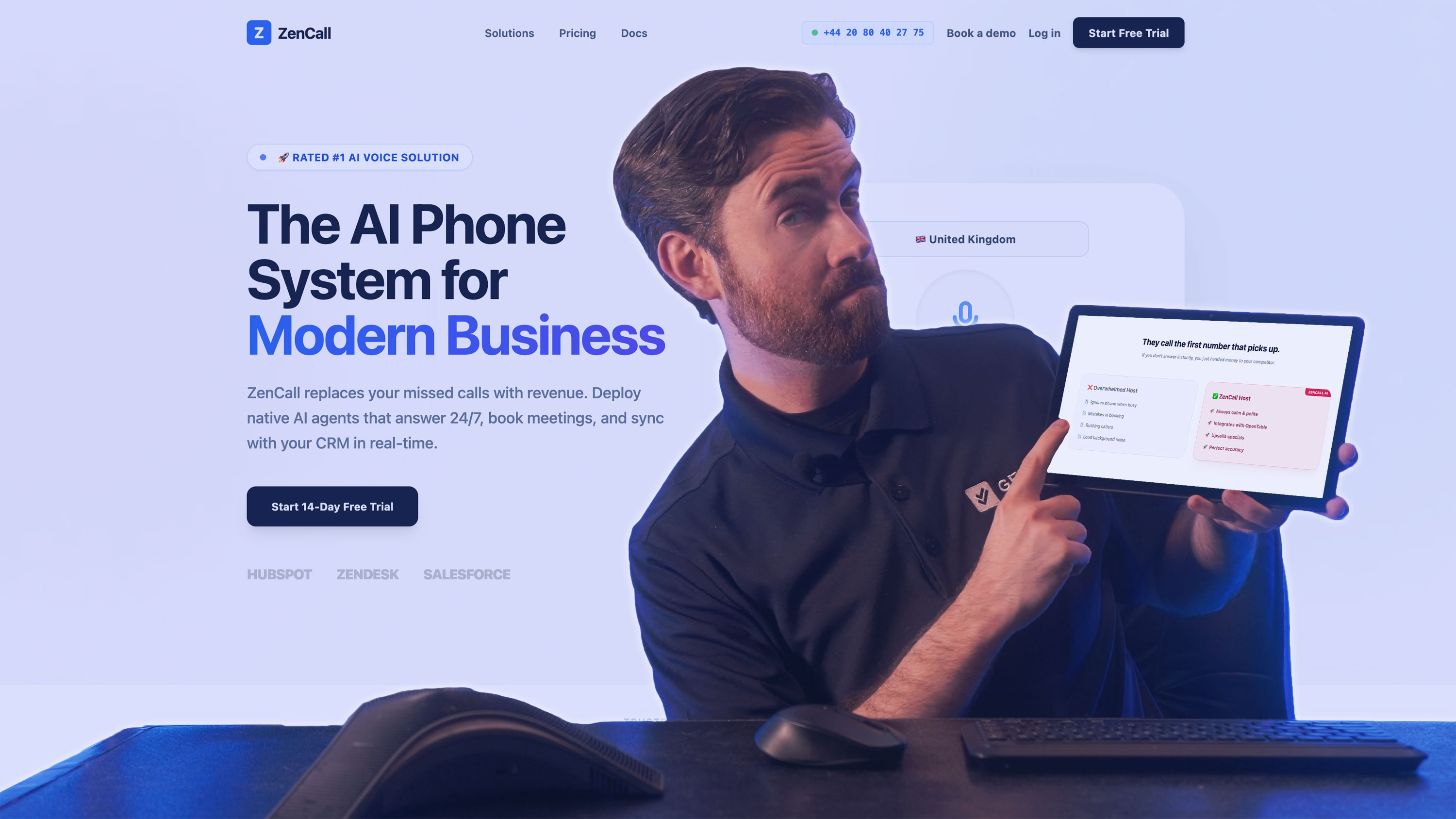
ZenCall.ai is built around conversational flexibility, on the premise that real callers don't follow scripts. The AI interpreted intent accurately when callers phrased requests imperfectly or deviated from expected patterns, reducing the frustration that comes with rigid automated systems.
We intentionally introduced ambiguous requests and indirect questions during testing, and ZenCall handled these scenarios better than several competitors, maintaining conversation flow rather than defaulting to fallback responses.
ZenCall also supports both inbound and outbound calling with CRM integrations across HubSpot, Zendesk, and Salesforce on the base plan. Higher tiers add predictive auto-dialing, bulk SMS campaigns, multi-level routing, and HIPAA and SOC2 compliance for regulated industries.
What we like
- Natural, adaptive conversations: The AI adjusted to varied caller inputs without requiring rigid phrasing, reducing dead-end responses
- Flexible call flows: Rather than forcing callers through predetermined paths, the system allowed organic conversation progression with clarifying questions when intent was unclear
- CRM integrations on every plan: Even the entry-level tier includes standard integrations with HubSpot, Zendesk, and Salesforce, plus AI call summaries and SMS support
What we don't like
- Limited reporting and analytics on lower tiers: Teams wanting sentiment analysis, real-time call coaching, or deeper performance metrics will need the top-tier Premium plan
- No compliance features below Premium: HIPAA and SOC2 compliance are only available on the top-tier Premium plan, which limits ZenCall for healthcare and financial services businesses on a budget
Pricing
ZenCall uses a minute-based model ranging from $29 to $149/month (billed annually), with consistent $0.09/minute overages across tiers.
Included minutes scale from 100 to 300+, and higher tiers add dedicated numbers, advanced routing, predictive dialing, and HIPAA/SOC2 compliance on the top Premium plan.
Every plan includes smart routing, CRM integrations (HubSpot, Zendesk, Salesforce), AI summaries, and SMS. A free trial is available on the lower tiers.
Best for: Businesses that need CRM-integrated call handling with compliance options and don't want to overpay for minutes they won't use.
Skip ZenCall.ai if: You need HIPAA or SOC2 compliance but can't justify the $149/month Premium plan that gates it.
VirtualReception.ai
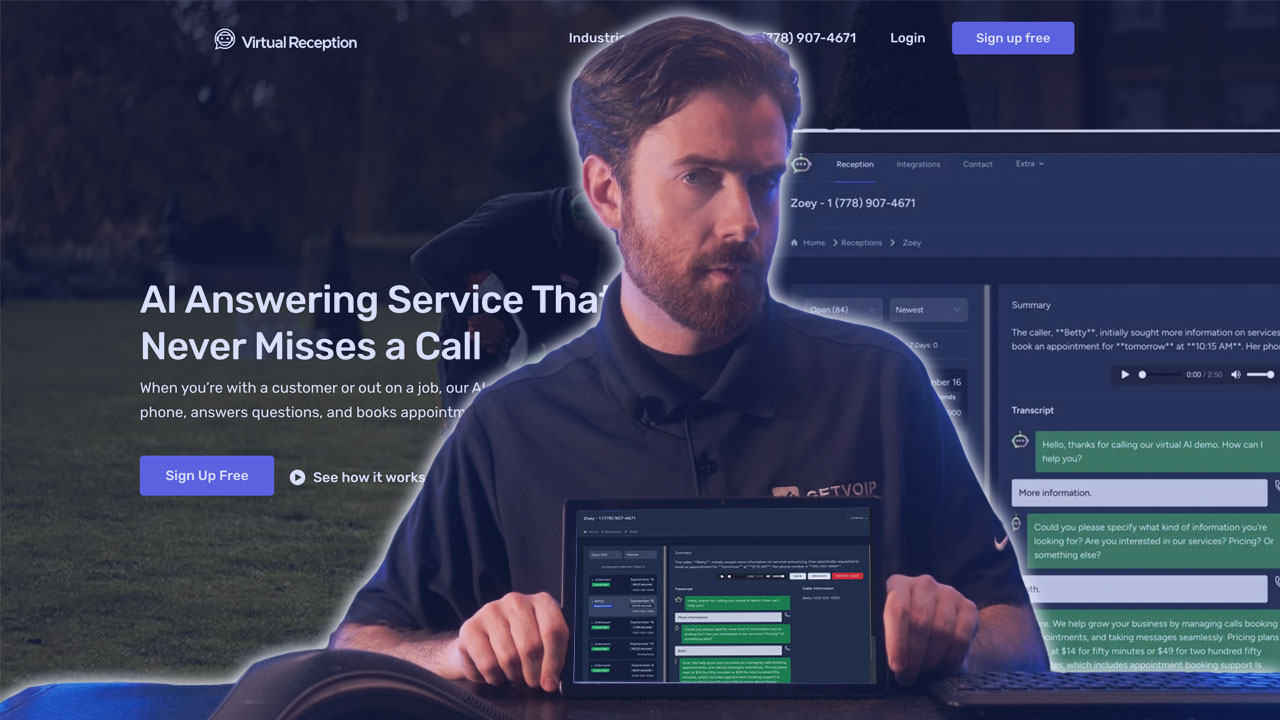
VirtualReception.ai is a no-frills AI answering service built for very small businesses and solo operators who want a working receptionist without any manual configuration. Its standout trait is auto-training -- paste in your Google Business Profile URL or website, and the system builds its own FAQ and pulls your business details before you've written a single script.
That auto-generated knowledge base handles the basics out of the box: business hours, services, location, and common caller questions, with manual edits available when the scraped details need correcting.
The platform focuses on essential reception functions: answering calls, capturing caller information, providing basic business details, routing calls, and booking appointments through Google Calendar. It handles these tasks reliably without the complexity of feature-rich competitors.
What we like
- Near-zero configuration: The auto-setup from your website or Google Business Profile got us to functional call handling with almost no manual input, among the fastest deployments we tested
- Lowest entry price: Plans start at $49/month, making professional AI call answering accessible to very small businesses, solo operators, and those testing AI reception for the first time
- Simple admin experience: The interface avoids unnecessary complexity, allowing non-technical users to manage settings without confusion. Updates to your knowledge base or greetings are straightforward
What we don't like
- Basic analytics: Reporting provides call counts and basic logs but lacks the depth needed for performance optimization or trend analysis
- Limited features on the entry plan: The $49/month Answering Service tier covers message-taking and notifications only. Appointment booking, integrations, call transfers, and text links require the $149/month Business plan
- Less conversational depth: The AI handles standard requests competently but struggles with unusual questions or complex caller needs compared to platforms built specifically for natural dialog
Pricing
VirtualReception.ai uses a minute-based subscription that ranges from $49/month to $299/month, scaling mainly on included minutes and capabilities.
The entry tier covers message-taking and notifications only. Moving up unlocks appointment booking, integrations, call transfers, and outbound calling, with minute allowances climbing from 250 to 2,000. Enterprise pricing is custom and adds CRM integrations plus unlimited receptionists and users. Overage rates aren't published, so confirm them before committing.
Best for: Solopreneurs and very small businesses that want basic AI call answering at the lowest possible monthly cost.
Skip VirtualReception.ai if: Your business depends on calls converting into bookings, since appointment booking and transfers require the higher-tier plan.
Frontdesk
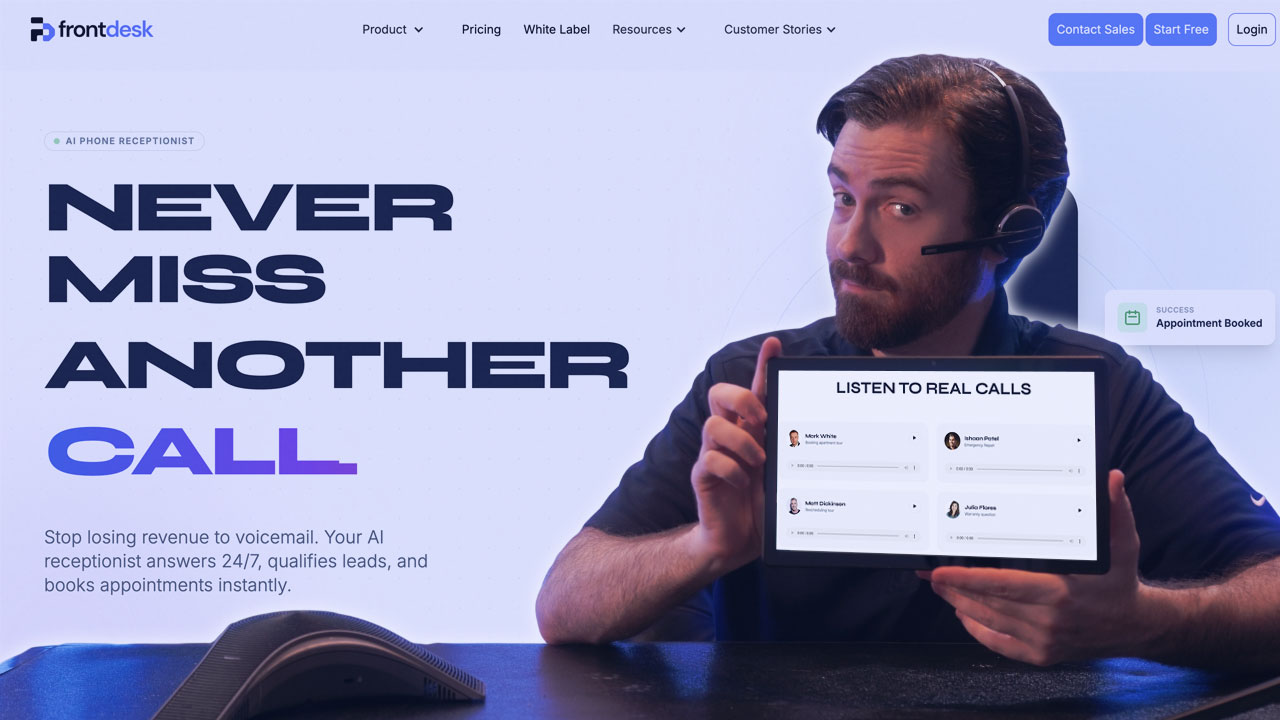
Frontdesk is a scheduling-first AI receptionist built for businesses handling anywhere from 10 to 10,000+ calls per day. The platform performed well across appointment booking, lead capture, and general call handling, with the AI navigating caller requests accurately and consistently.
Frontdesk has evolved into a full lead management platform, not just a receptionist. The platform combines AI call handling with a built-in CRM, ticketing, workflows, and outbound sequences on higher tiers. It supports 100+ premium voice options so you can customize how your receptionist sounds, and integrates with scheduling tools, CRMs, and 6,000+ apps.
The AI receptionist also handles texting workflows during calls, so if a caller asks to book an appointment, the receptionist can text them your scheduling link in real time.
What we like
- Strong calendar and scheduling accuracy: The AI correctly identified available slots, avoided double-booking, and handled rescheduling requests without requiring human intervention
- Full lead capture platform: Beyond basic reception, Frontdesk includes a CRM, ticketing system, and workflow automation that turn calls into trackable opportunities rather than just logged messages
- Broad integration ecosystem: Connections with scheduling tools, CRM systems, and 6,000+ apps cover most small business workflows. The Growth plan adds advanced analytics and up to 6 custom workflows
What we don't like
- Higher entry price than basic competitors: At $99/month, the Business-in-a-Box plan costs more than simpler AI receptionists. Businesses that only need basic call answering may find it more platform than they need
- Key features gated behind higher tiers: Unlimited workflows, 6,000+ integrations, advanced analytics, and outbound sequences all require the Growth plan ($149/month) or the Full Platform tier
Pricing
Frontdesk offers a free plan, a Business-in-a-Box plan at $99/month, a Growth plan at $149/month, and a quote-based Enterprise tier.
The $99 plan covers up to 10 calls per day with 200 voice minutes, 100+ premium voices, and a dedicated account rep. Enterprise adds advanced analytics, unlimited workflows, and volume overage pricing. Annual billing saves 20%.
Best for: Appointment-driven service businesses that want AI reception, CRM, and lead management in one platform.
Skip Frontdesk if: You only need basic call answering, or your call volume is low and steady, where simpler tools deliver the core function for less.